The Most Underrated Innovation in Bitcoin
If you ask people what makes Bitcoin work, they’ll point to proof-of-work, decentralization, the 21M supply cap, or the halving schedule. All true.
But the feature that quietly keeps the entire system stable, and almost nobody talks about, is the difficulty adjustment.
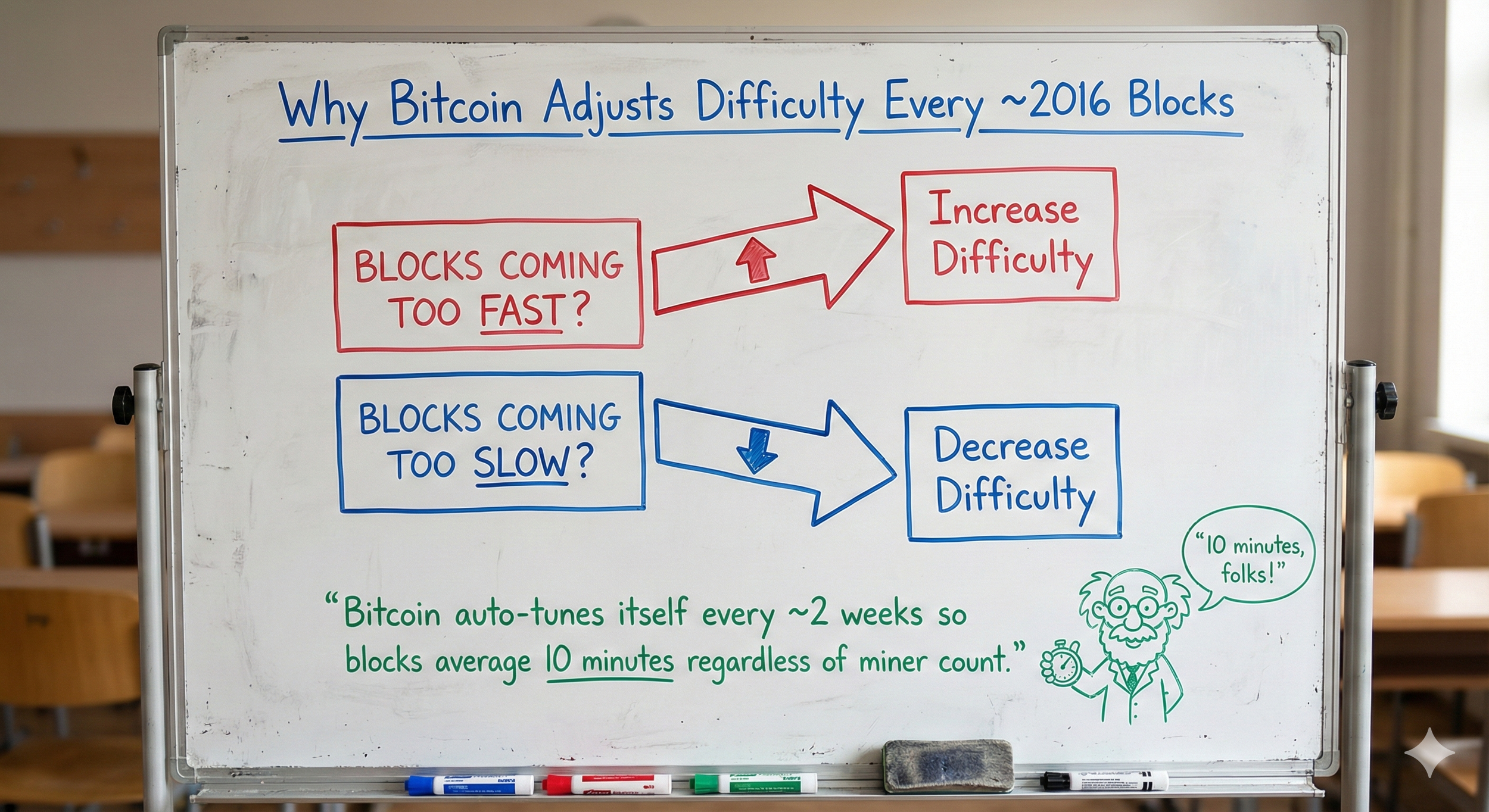
Bitcoin’s difficulty mechanism is a simple two-week control loop that keeps block times near ten minutes, no matter how many miners join or leave the network.
Every ~2016 blocks, Bitcoin runs a tiny feedback loop. It asks a simple question: “Are blocks arriving too fast or too slow?”
If miners are sprinting and blocks are coming in under 10 minutes, difficulty ratchets upward. If miners shut off, whether due to price crashes, energy shocks, or geopolitical events like the China mining ban, difficulty eases. The protocol self-corrects.
This control loop is deceptively powerful. It neutralizes Moore’s Law by making hardware improvements irrelevant to Bitcoin’s issuance schedule. It prevents runaway block production. It absorbs massive swings in global hash power, sometimes half the network disappearing overnight, and still delivers a steady, predictable heartbeat: one block every 10 minutes.
It also shapes who mines Bitcoin. Over time, miners have evolved into scavengers of stranded or nearly-free energy: natural gas flares in North Dakota, midday solar oversupply, regions where electricity is cheaper than transporting the fuel. They’re the opposite of hospitals or factories. They want to be the first customers shut off during a grid crunch in exchange for the cheapest possible rates. When things get unprofitable, they simply power down. Bitcoin adjusts. Equilibrium returns.
Most systems fall apart when participants change behavior unexpectedly. Bitcoin quietly adapts every two weeks, no central authority required.
The difficulty adjustment is the invisible flywheel that keeps the network balanced. Whether through booms, bans, miner migrations, hardware revolutions, and energy shocks.
A tiny control loop, buried deep in the protocol, is why Bitcoin survives chaos.
